
Michael Palma - Interiew
The Divine Comedy
Michael Palma - The Divine Comedy
This post is an interview with Michael Palma. Way back in 2002 Palma published his translation of the Inferno. Here we are twenty some-odd years later and we can finally get our hands on his translation of the complete Divine Comedy. This is very exciting! Why? Because Palma’s translation is in terza rima and it accomplishes this difficult format quite sucessfully! Recent translations, though excellent in there own way, tend to shy away from any concrete format, so a return to the ol’ terza rima makes me happy.
You may skip my below panegyric on terza rima and structure if you wish. The interview starts after the images.
My Panegyric
My personal favorite format for a translaion of Dante is terza rima. Don’t get me wrong, there are a lot of excellent translations, I read them all, but Dante chose this format for a reason and I think it is an important part that, when missing, the poem seems to lose some of its power, like kryptonite to Superman. The poem is already losing enough power through the translation.
In a class earlier this year (yes, I’m an English teacher) I had a lesson on how, at times, the structure of a poem is integral to the theme of a poem (example: Natasha Trethewey’s Myth1). The Divine Comedy is one such poem. Simply put, to me the terza rima structure represents the interconnectedness of Dante’s journey which, in turn, is our interconnectedness to the Divine. It is a constant, yet subtle, reminder throughout the poem that this connection is there, always, whether we are aware of it or not. Further, this interlocking is in threes. You know, Trinity, Divine. I did start off stating “simply put” and this is not my classroom. ‘Nuff said.
Lastly, translations of Dante into terza rima are often criticized because English lacks the rhymes and the language in these translations can sound clunky, stilted, and forced. This translation proves that wrong.
Thank you, Michael.

To buy Michael’s translation, click HERE.
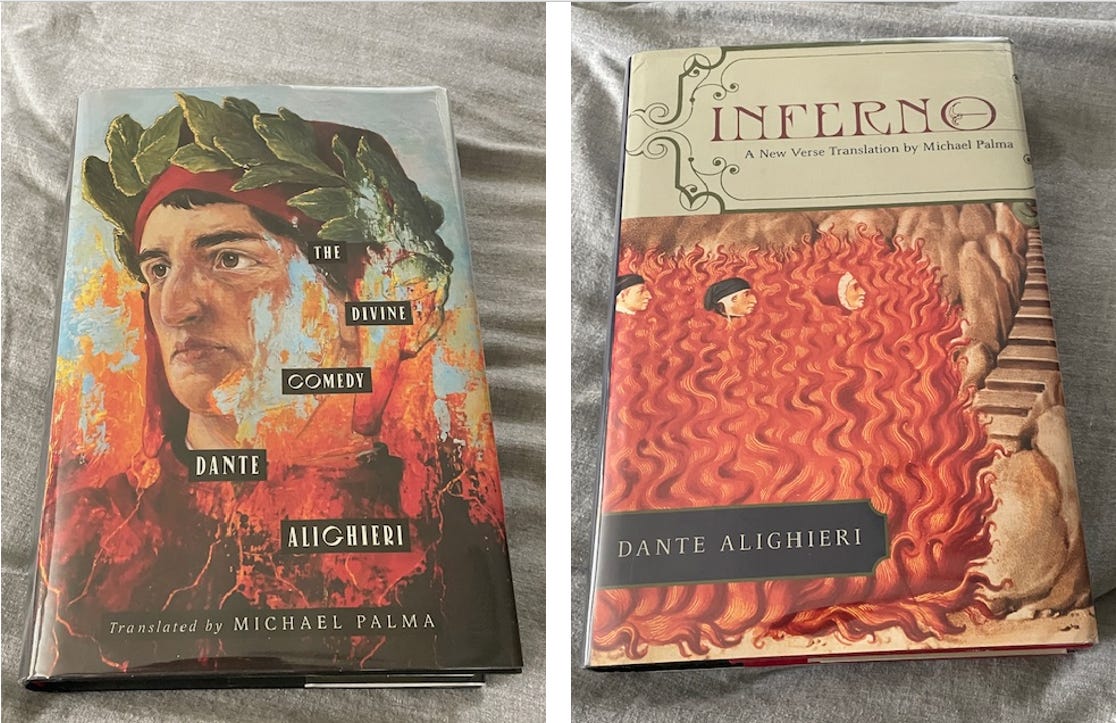
Michael Palma - The Interview
A brief Bio
Born in the Bronx in 1945, I lived in Westchester County, New York, for nearly fifty years before moving to Vermont in 2005. I have published several collections of poetry, a book of essays, and twenty translations of modern and contemporary Italian poets, including Guido Gozzano, Giovanni Raboni, and Luigi Fontanella. My Inferno was published by Norton in 2002, and my complete Divine Comedy by Liveright in 2024.
With so many existing translations of Dante, why did you decide to add yours? Was the reason personal, professional, or something else?
I didn’t originally set out to do a complete translation. In 1994, after participating in the first annual Inferno reading at the Cathedral of Saint John the Divine in New York, I decided to translate my own canto (VI) for the following year’s reading, and again (XIII) for the year after that. At that point I decided that I might as well go ahead and do a complete Inferno.
Were these cantos from the Inferno (6 and 13) or any cantos published prior to the 2002 Inferno release and were there any cantos published prior to the release of your Comedy?
Canto XIII was the only one published before the Inferno. Cantos appearing in journals before the publication of the Comedy were Purgatorio, Cantos I-III, XI-XII; and Paradiso, Cantos III-IV, XXI-XXIII, XXIX, XXXII-XXXIII.
Why did you choose terza rima for your translation?
I’ve always translated formal poetry in the meter and rhyming pattern of the original poem. Quite simply, I chose terza rima because Dante had.
Why did you decide not to have illustrations?
I didn’t specifically decide to exclude illustrations. I never thought about including them, on the ground, I suppose, that the text should—and does—speak for itself.
Did any earlier translations inspire you?
Insofar as any previous versions were a positive inspiration, I would cite Ciardi and Mandelbaum as demonstrations that a translation of Dante should be a fluent, natural poem in English, not a trot or a museum piece.
Did you consult any commentaries or earlier translations?
While translating the Inferno, I checked my own versions against Singleton, Hollander, and Durling for both accuracy and background, and to a lesser extent I consulted Ciardi, Sayers, and Binyon. It seemed perverse not to rely on these resources when they were available to assist me in understanding the text. When I translated the rest of the Commedia, I went back to those and also looked at Mandelbaum, Musa, and Esolen for the same reasons, but also to be sure that I avoided accidentally duplicating their phrasing or, in the relevant instances, their rhymes.
Which Italian version did you use for translation or did you exclusively use (what I call) post-translation sources (like Charles Singleton or Mark Musa)?
I used Singleton as my principal source for the Italian original, and for his English rendering as a backup.
Did you have a particular routine or method for translating?
I worked on groups of two or three tercets at a time, fixing the literal meaning as closely as possible in my mind, then working out the rhymes for that passage. After each canto was completed, I would go through it carefully and revise, with a particular emphasis on improving its quality as poetry in English.
From start to finish, how long did the translation take?
The Inferno was done in two separate stretches of about eighteen months each, while I was working a full-time job. The rest was translated much later, when I was retired; this took four years, two for each canticle.
Did you prioritize literal accuracy, poetic flow, or something else? What was your reasoning behind that?
I didn’t prioritize any one quality over all others. To quote from the “Note on the Translation” in my Comedy, “…[R]ather than begin with a hierarchy of values which dictates that some of the components of the original must be downplayed, or even eliminated, at the expense of others, I hope to salvage as high a percentage as I can of all the elements of the poem. In practical terms, this approach means that every problem of translation must be solved not by the unflinching imposition of some abstract theory or principle, but by the immediate needs, in context, of that particular moment of the poem.”
Similarly, what was your approach to balancing faithfulness to the original with readability in English?
I tried as much as possible to keep an equilibrium between them, but in instances where a choice might have to be made, I would emphasize faithfulness over readability.
Can you give an example of a translation choice that involved a tough compromise?
To quote from my Comedy once again, this is my note to the last lines of Canto XXVI of the Purgatorio: “The eight lines of [Arnaut] Daniel’s speech are written in Daniel’s own langue d’oc [the language of the troubadors]. Quite a few translators ignore this change of language, while a number of others simply italicize the lines. With greater enterprise, Dorothy L. Sayers ‘translated the speech into Border Scots—a dialect which bears something of the same relation to English as Provençal does to Italian’; be that as it may, the result is tonally quite discordant. Rather more successfully, John Ciardi renders the lines into what he describes as ‘a desperate attempt at bastard Spenserian.’ Since his achievement here has, I feel, foreclosed that option, I have (dis)contented myself with a bit of rhetorical heightening.”
What was the most difficult canto or line to translate, and why?
Canto XII of the Purgatorio presented a major formal challenge in the elaborate acrostic passage of lines 25-63, which demanded adherence to the acrostic itself, parallel phrasing in the beginnings of tercets, and keeping each tercet self-contained.
Do you have a favorite canto or line? Why does it speak to you?
It’s hard to make a single choice from among hundreds of wonderful lines and passages, but I still feel that, for superb writing that creates an effect of intense emotional power, nothing surpasses the Ugolino episode in Canto XXXIII of the Inferno.
How has translating Dante changed you intellectually, spiritually, emotionally?
The only way that I’m aware of is that I now seem to have much more demanding standards for any other poetry that I might consider translating.
What do you hope readers take away from your version?
Many things, but more than anything else the astounding greatness of Dante’s imagination, depth of humanity, and poetic artistry.
Could you include an excerpt that would be a prime representation of your translation?
A favorite passage of mine, largely because of its formal challenges, is the expanded and annotated version of the Lord’s Prayer that begins Canto XI of the Purgatorio:
“Our Father who art in Heaven, not held by
any constraint, but by Thy demonstration
of greater love for the first things made on high, 3
hallowed be Thy name and might in exaltation
by every living thing, for it is right
to render thanks for Thy sweet emanation. 6
Thy kingdom come, and let its peace alight
upon our souls, for if it is not given
we cannot come to it, strive as we might. 9
Thy will be done on Earth by men who are driven
to sing Hosanna and let their wills be led
by Thine, as angels do, as it is in Heaven. 12
Give us this day, we pray, our daily bread,
without which those who strive most to pass through
this bitter desert must fall back instead. 15
Forgive us our trespasses as we too
forgive those who trespass against us, rather
than hold us to the judgment we are due. 18
And lead us not into temptation, Father,
to which we are so readily inclined,
but deliver us from evil, from the Other, 21
the ancient foe who so infects the mind.
Lord, this last prayer is not for us, because
we have no need, but for those who remain behind.” 24
Myth
Natasha Trethewey
I was asleep while you were dying.
It’s as if you slipped through some rift, a hollow
I make between my slumber and my waking,
the Erebus I keep you in, still trying
not to let go. You’ll be dead again tomorrow,
but in dreams you live. So I try taking
you back into morning. Sleep-heavy, turning,
my eyes open, I find you do not follow.
Again and again, this constant forsaking.
*
Again and again, this constant forsaking:
my eyes open, I find you do not follow.
You back into morning, sleep-heavy, turning.
But in dreams you live. So I try taking,
not to let go. You’ll be dead again tomorrow.
The Erebus I keep you in—still, trying—
I make between my slumber and my waking.
It’s as if you slipped through some rift, a hollow.
I was asleep while you were dying.
https://readalittlepoetry.com/2021/04/15/myth-by-natasha-trethewey/
Accessed 28 May 20025.