
Marco Sonzogni - Interview
Dante Scholar

Unsung Heros - Dante Scholars
I was ranting to a friend about a wonderful production I saw of Henry IV, Part 1. They asked me what made it so great. At the time I gave a generic answer full of positive adjectives. Recently, I revisited this memory and began to really think about what made the show so great. Specifically, what made it so awesome was how the costumes, lighting, sets, actors, directing, even the set changes, all worked seamlessly together to successfully create that ‘suspension of disbelief.’ But it was more than that. Together they created a hypnotic immersive reality.
(Aside) The actor playing Falstaff stole the show.
What does this have to do with Dante?
When I started interviewing translators it occurred to me that Dante scholars are like those behind-the-scenes theatre people who create the costumes, sets, lighting, etc., everything that makes a production shine. They are integral for a productions success. Without much credit they lay the groundwork for the magic.
Dante translators, like actors (I am using the word ‘actor’ as a gender-neutral noun), get a lot of well-deserved attention because they’re the ones wrestling with archaic Italian, terza rima, and all the layered meanings packed into every line, yet Dante scholars are just as deserving. They are the ones who provide the foundations that make a good translation possible. They set the historical context, untangle theological ideas, find philosophical influences, and decode Dante’s references. Without this groundwork, even the most passionate translator with the best intentions can be misled. The analogy that came to me was:
Scholars supply the keys; translators use them to open the door.
But then I thought:
Scholars are Dante’s Virgil…
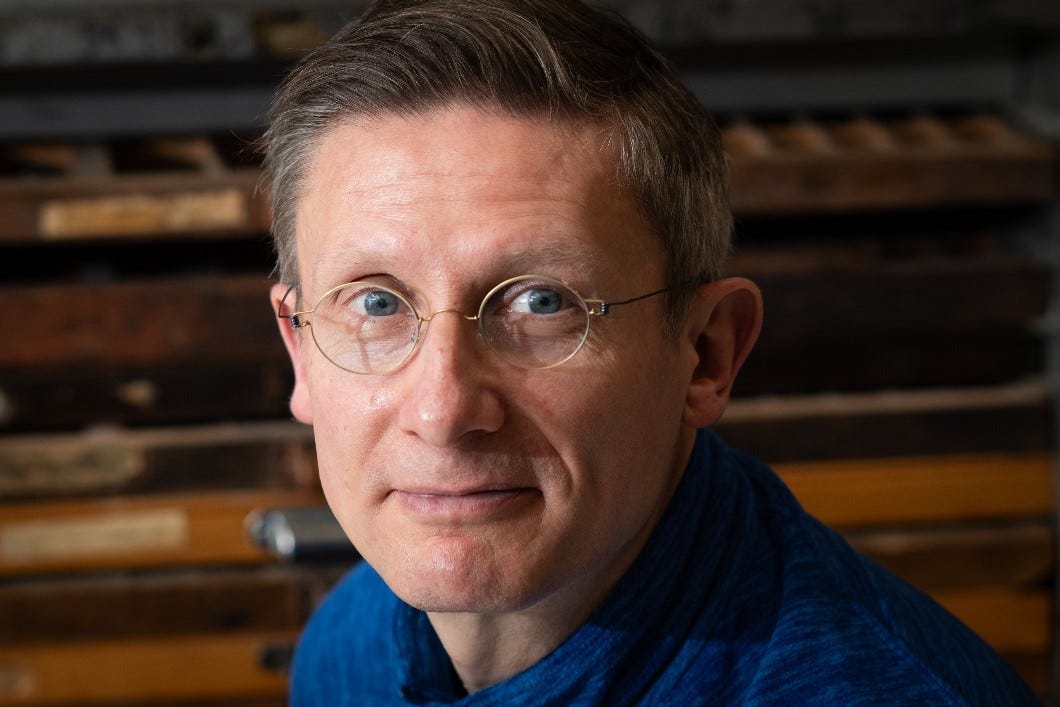
Marco Sonzogni
I first emailed Marco many, many moons ago when doing research for my book Danteggiare (a new revised editon is almost done!) and he sent me a PDF of his book (with Tim Smith) To Hell and Back. The book is an anthology of English translations of the Inferno where there is a different translator for each of the cantos, 1-34, then back, 34-1. There are two extra cantos (1 and 2) thrown in at the end, one of which by Patrick Worsnip who was the subject of a previous interview.
Recently, Marco emailed me out of the blue to ask me a question, and this came after I started posting interviews… and that’s when the idea to interview scholars hit me. I asked him to do an interview and he said yes, so here it is. Thank you Marco!
Marco has quite a few publications available. To Hell and Back (mentioned above) is HERE . A genreral link to his publications is HERE. I myself will definitely be getting the Translations of Seamus Heaney, obviously a must read (and maybe Re-Covered Rose, it sounds fascinating).
A Brief Bio
Marco Sonzogni (OMRI)* is Professor of Translation Studies at Te Herenga Waka-Victoria University of Wellington, where he researches and teaches evolutionary translation and intercultural communication. He is a widely published and award-winning scholar, literary translator, editor, and poet.
His work has focused on two poets and Nobel Laureates, Eugenio Montale (1896-1981) and Seamus Heaney (1939-2013). He owes to his mother Marilena, a secondary school teacher of Latin and Italian, a passion for Virgil and Dante; to his late father Mario, a secondary school teacher of maths and chemistry, a passion for Primo Levi and the intersections between science and literature; and to his brother Gabriele, a headmaster, a passion for the creative rigour of philology and computer science.
*OMRI stands for Ordine al Merito della Republica Italiana (Order of Merit of the
Italian Republic). This is Italy's highest ranking honor given to those who have accomplished some outstanding achievement for the country.1
The Interview - 1 May 2025
Could you share with us how your scholarly engagement with Dante began? Was there a defining moment or passage that sparked your focus?
My mother was a secondary school teacher of Latin and Italian – this means Virgil’s Aeneid and Dante’s Divine Comedy, like master like pupil, no? George Steiner, a great scholar, and great provocateur, once said that Dante’s Divine Comedy is an appendix to Virgil’s Aeneid… Anyway, early exposure for sure, which means fear, or rather awe, for those immortal masters. Then I studied Dante systematically in school and at university. Then a pause, until my work on Seamus Heaney begun in earnest and his engagement with Dante, especially with the story of Ugolino, started my second and possibly even deeper engagement with Dante. So, for many years the harrowing end of Count Ugolino and his children was the passage that gripped my mind and heart and soul – painfully and, as far as the poetry goes, beautifully. Until the simile of geometer to explain the human mind’s effort to capture the divine in the last canto of Paradiso, sort of replaced it… This happened recently, while reviewing Michael Palma’s painfully and beautifully precise translation of the Commedia… well his version of that simile brought me to tears!
How has your understanding of Dante evolved over the years?
Dante is an encyclopaedic and a visionary writer. A lifetime of study is not enough to capture his genius and his writing fully. This is to say, our understanding of him and of his work must evolve to be able to get what he is trying to do. Of course, there are passages we can readily access and enjoy but… well, that is like playing level 1 of a videogame that has 100 levels. How far we want to go requires a development and advancement of skills…
What is your favorite canto or passage in the Divine Comedy and why?
Bronze Medal: Purgatorio I, the bit about ‘miglior acque’, ‘more favourable waters’, which puts my current location, Aotearoa New Zealand, as close to Dante’s imagination as possible in terms of where he located the shores and the mountain of Purgatorio.
Silver Medal: Paradiso 11, St Francis’ life, the bit St Francis receiving from Christ the ‘ultimo sigillo, the ‘ultimate seal’, the stigmata. And the burial in the earth, with his body as coffin. I re-read this passage when I received the news from my mother that Pope Francis had died.
Gold Medal: Paradiso 33. I don’t think poetry can get any more beautiful and powerful and moving than here – and any more real, in the sense of human, as it fails to grasp what is above human – divine in this case. So, the simile of the geometer is perfect in the human imperfection it encapsulates.
How should modern readers approach the Divine Comedy, especially those new to it?
First read it a story and stick with it to the end like one should do with any story. Because it is the story of our humanity. And then re-read it with the intention of finding out more about all the characters and their circumstances – geographical, historical, cultural, societal, political in order to understand Dante’s mind and his times, and contextualize his response.
How would you explain Dante’s continued relevance in the 21st century?
As I’ve just said, the story we read in the Commedia is the story of the human being – the good and bad of us as a species, and what we are capable of when we set our mind to good and bad things, how low and how high we can go. To me, personally, it is a book of hope – hope to make it through to the end. So regardless of one’s own beliefs of faith, hope is what can save us and take us from the abyss of desperation and failure (inferno) to a stage of healing and renewal (purgatorio) and to a sense of completion and fulfilment (paradiso). Many of the things Dante experienced in his times – civil war, for instance, the hatred and back-stabbing enveloping political ambition (including his own), power-distance, the power of money and so on… all these things, all these evils, are still with us. So why should Dante’s description of them and response to them not offer us warning, guidance, and comfort?
Are there modern authors or thinkers you believe are “Dantean” in spirit or method?
Off the top of my head, I would say the Irish poet and Nobel Laureate, Seamus Heaney (1939-2013). In many ways he was, the civic commitment, the Catholic inheritance, the ethics of what Montale called everyday decency, the hope in the future. And the energy of poetic vision and language, of course. In the end Virgil edged Dante perhaps in Heaney’s poetics and imagination but Dante is there too, from start (when he runs away from him) to finish (when he embraces him, including the last canto of Paradiso).
For those unfamiliar, why is Dante considered such a pivotal figure in Western literature and thought?
For the combination of personal and poetic matters, for embarking on and documenting an inner journey and development we are all called to pursue or should be called to pursue. And, of course, for the power of faith to give us hope and purpose in this life as well as in, well, the next life, for those who believe. Also, for the absolute power of language to capture all aspects of human life on earth and give us a glimpse of the divine too – very few poets can do with language what Dante has done.
Homer? Shakespeare?
Why do you think The Divine Comedy has endured for over 700 years?
Because it is about what everywoman and everyman goes through from birth to death.
Nothing has changed much from that respect and Dante is a trustworthy companion, strict but also soothing; judgmental but just; visionary but also very real.
The Divine Comedy is often read as a theological work, a political treatise, and a literary masterpiece. Which of these dimensions do you find most central or are they inseparable?
They were inseparable for Dante and that is what I think we should bear in mind reading him. Separating those dimensions, as you have rightly called them, would compromise the ultimate meaning of the whole work. If others want to do it, they can, of course, but they will miss out on something important, special, unique in fact.
Do you have a preferred English translation of the Divine Comedy? Why?
I will say Michael Palma now. Robin Kirkpatrick’s, Mark Musa’s and Allen Mandelbaum’s have been with me for years. More recently, Clive James’s and Alasdair Grey’s. At times I need scholarship, at times I need poetry at times I need entertainment, at times I need complexity, at times I need simplicity. I don’t think a single translation can achieve all that – but am not an English native speaker.
In any case, as you know better than anyone else on this planet, there’s a Dante for everybody!
Related to the previous question, is there a “best” translation for first-time readers? What about for scholars? What about for teaching and what makes it effective?
I would suggest both students and teachers to read different versions to find the one that suits them best. For instance, I have invited my students to read Robin Kirkpatrick’s and Clive James’s. And I will now ask them to read Michael Palma’s and Alasdair Gray’s. And perhaps bits of the Inferno in Seamus Heaney’s and Ciaran Carson’s translations.
What’s a Dante quote or lesson you carry with you in everyday life?
“Non ragioniam di lor, ma guarda e passa” (Inf III,51). There comes a moment when this precious advice is to be enacted. When listening to others is weighing us down rather than lifting us up, then it is time to move past them, past it, even past our own self, and move on. Often, we crowd our mind with so many words – other people’s words – we end up no longer hearing our own voice and needs. That is how I have taken this line to mean anyway! Not to be too serious, I should also single out “Ed elli avea del cul fatto trombetta” (Inf XXI 139). When things get really tough or scary, a bit of humour can make the difference… an injection of true comedy in the tragedy of evils and devils.
What can modern readers take from Dante spiritually, politically, or personally?
I think Dante offers an example, in fact an embodiment of rectitude based on civic and spiritual commitment, of principles and values translated into everyday action. Dante wasn’t exactly an easy person to deal with himself, but this is why he is so resolute, faithful, and hopeful. In a better Florence, in a better Italy and of course in a better world. Starting with a better language…. So much to say there…
Often, I think – what would Dante make of Trump or Netanyahu or Putin or Zelensky or Pope Francis – or the Roman Curia. Imagine Mr Alighieri reporting on the Conclave…
What should readers keep in mind when reading a translation of The Divine Comedy?
I always admire, and trust, any translator who takes on Dante, even when the translation turns out to be not particularly effective for one reason or another. And to those who hastily and harshly criticize a translator/translation, I would say: What about you try doing it yourself and see if you what you come up with?! There we have it.
Have you ever attempted translating Dante yourself? If not, why? If so, can we see a passage?
At some point in my university days, while studying the history of the Italian language with a very renown dialectologist, I started putting some lines in my local dialect. They must still exist somewhere… next time I go home I will look among my old, cobwebbed notebooks from the early 1990s…
Anyway, once on a plane from Wellington, Aotearoa New Zealand, to Tokyo, Japan, I ended up talking about Dante with a very distinguished middle-aged Japanese lady now living down under. She told me she had heard about The Divine Comedy and asked me what it’s all about. This little haiku – appropriate for the occasion, I thought – came to me and I wrote it down at the back of the boarding pass she was using as bookmark. The during, the middle line, is all three canticas… the before well know what it is like, life on planet earth, and the after well… for us believers we can only hope the promise is kept! So here is my haiku:
A mid-life crisis.
Pain than pause than promise – phew!
Endless ecstasy.
A Final Word from me…
Ok, I couldn’t help myself. I have been writing and trading haiku daily with my BFF Tom going on 12 straight years. Marco, you inspired me, so I felt obliged to take a crack at one.
From lost to redeemed,
A poet maps the soul’s quest,
And we follow still.
“Commander of the Order of Merit of the Italian Republic.” University of Toronto. Department of Italian Studies. https://www.italianstudies.utoronto.ca/awards/commander-order-merit-italian-republic. Accessed 26 July 2025.
Bill, Brilliant!
life breathed into soul
story imagined, boldly related
a poet's work